
Residential Rates

How are rates set?

To set electric rates the Logan County Electric Cooperative board of trustees must balance lender financial requirements, paying long-term debt, returning capital credits to members, total margins and equity, depreciation and amortization expenses, operating margins, total assets, and more. 

They desire to ensure the best rates are set for our Co-op members. 

This difficult task is one of the reasons why the LCEC trustees attend cooperative director courses. 

Rates that are as low as reasonably practical, yet ensure the long-term health of the cooperative.
3 Types of Charges

Generation and Transmission (G&T)

These charges represent the costs associated with producing electricity and moving it across transmission lines to the LCEC substations. The G&T charges are billed to LCEC by Buckeye Power, a generation cooperative that provides wholesale power to Ohio’s electric cooperatives. These costs are passed on to our members without being marked up.

The generation and transmission rate is $.07565 per kilowatt-hour (kWh) of electricity. However, this rate is variable due to the fluctuating cost of fuel used in generating electricity and will be adjusted up or down each month so our members only pay the actual cost of the wholesale power.

Comparison of Basic Service Charge

Why is my service charge higher than other Investor Owned Utilities?  

Our rates are in line with other electric utilities when you consider our rural territory averages 6.7 members per mile of equipment, compared to investor-owned utilities, where one mile serves approximately 30 consumers. While it is true that our monthly service charge is higher, we collect a competitive amount per mile of distribution line and provide our members with a local, responsive, high-quality service.

Image
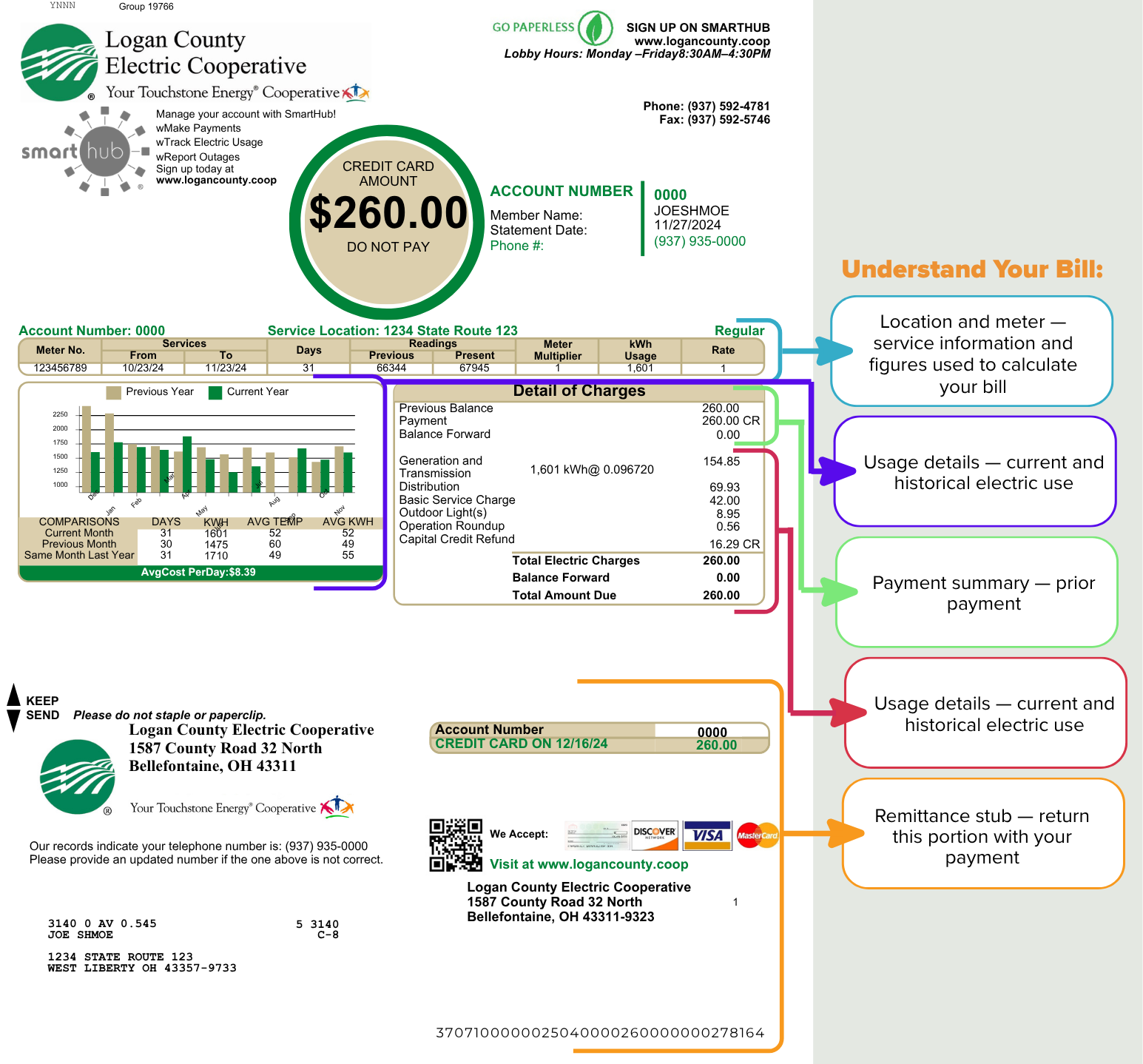
Understand your Bill
Image
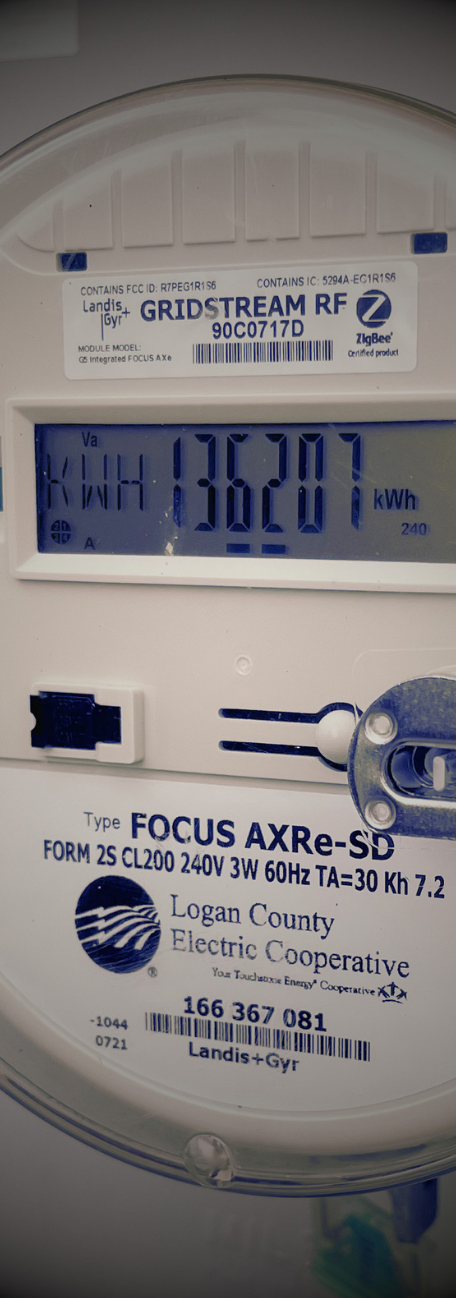
Meter

Kilowatts & Dollars

On your monthly bills, the charge for electricity is determined by the amount of kilowatt-hours (kWh) your home consumes.

What are kilowatts?

  • Watts measure how much power a device needs

  • 1 kilowatt (kW) = 1,000 watts

  • Every appliance uses a different amount of power

Examples:

  • Microwave: 1,500 watts

  • Pool pump (1.5 HP): 2,000 watts

  • Water heater: 4,500 watts


What is a kilowatt-hour (kWh)?

  • A kWh measures electricity used over time

  • 1 kilowatt (kW) running for 1 hour = 1 kilowatt-hour (kWh)

  • The average Logan County Electric Cooperative member household consumes 1200 kilowatt-hours each month.

Examples:

  • 40-watt TV → 25 hours = 1 kWh

  • 2,000-watt pool pump → 30 minutes = 1 kWh


What can 1 kWh power?

  • Dishwasher (1,000W) → 1 hour

  • Oven (2,000W) → 30 minutes

  • Refrigerator (300W) → 3 hours

  • PlayStation 4 (150W) → 6.5 hours

To pay less money on your electric bill, you must reduce the kilowatt-hours you use.