The rate change will take effect on bills rendered on or after April 1, 2026.
The average member will see a 6.45% increase to their bill.
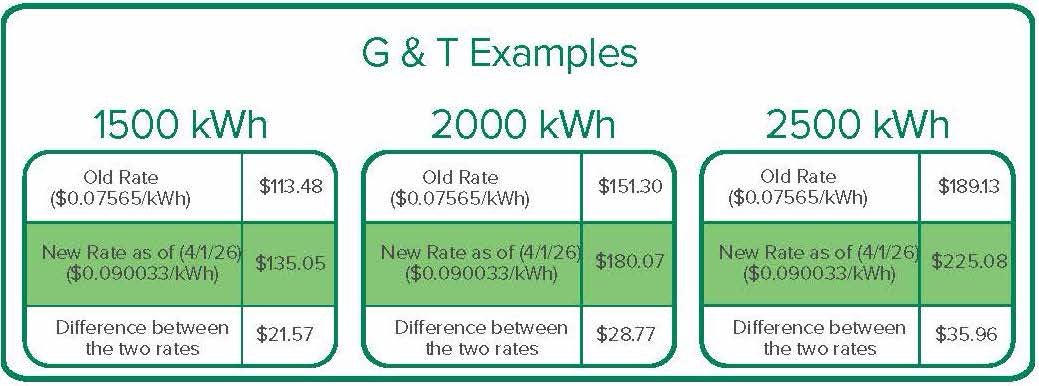
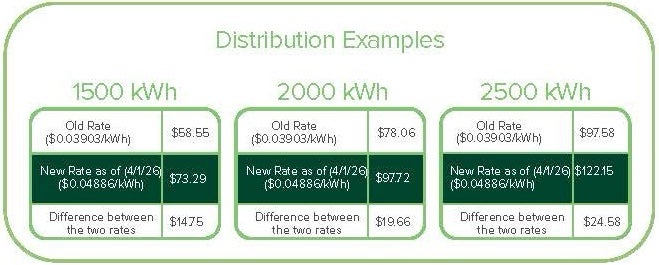
The basic service charge will increase from $42 to $47. The generation and transmission rate will change from $0.07565 to $0.090033 per kWh. The distribution rate will increase from $0.03903 to $0.04886 per kWh.
With rising costs, we must ensure financial stability so we can continue providing reliable service.
- Rising Costs
- We take a mindful approach to strike the right balance of keeping costs affordable for members and ensuring the long-term stability of your electric service.
- By conducting a Cost-of-service study, the Co-op realized that revenue is no longer keeping up with rising costs.
-
- A Cost of Service Study (COSS) is an analytical process performed by a third party used primarily by utilities (electric, water, gas) and other service providers to determine how much it costs to deliver services to different customer classes. The goal is to ensure that rates charged to customers are fair, equitable, and aligned with the actual cost of providing service.
-
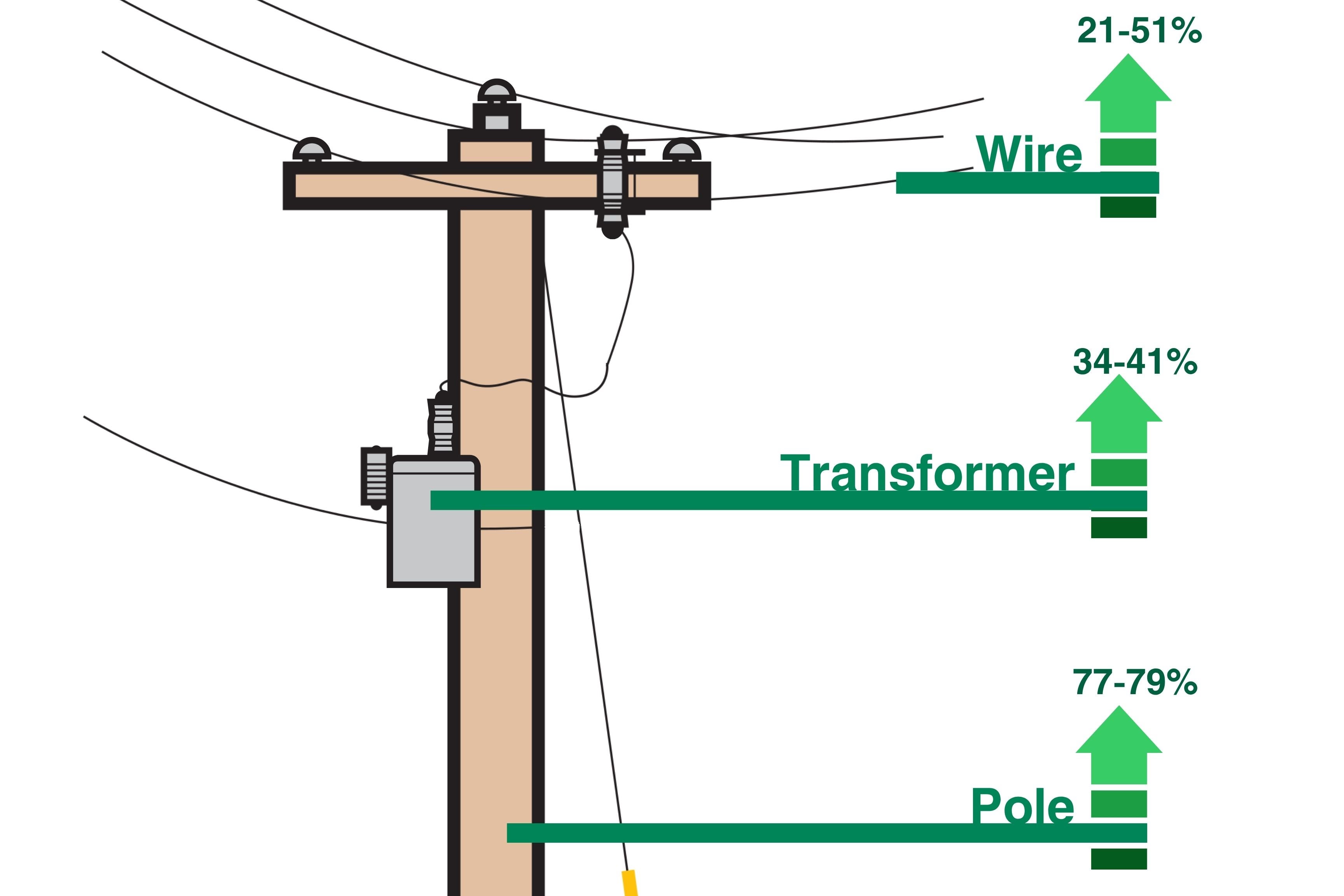
- In recent years, the cost of poles, wires, transformers, and other equipment needed to deliver power to your home has risen.
-
- Wire + 21%
- Poles + 79% (last 4yrs)
- Cost comparison: Ground beef + 38.9% & Eggs +80.8% (since 2022)
-
- Our last adjustment to kilowatt-hour rates was in 2017; nearly a decade later the cost of materials and energy has skyrocketed.
- Financial Stability
- As your not-for-profit electric provider, we work to keep your service affordable and reliable. As the costs of supplies associated with providing this service rises, we must raise rates to ensure the co-op’s long-term financial stability. Our last adjustment to kilowatt-hour rates was in 2017; nearly a decade later the cost of materials and energy has skyrocketed
- We strive to offer our members exceptional member service. We take a mindful approach to strike the right balance of keeping costs affordable for members and ensuring the long-term stability of your electric service. The co-op serves seven meters per mile of electric line, so we have a small number of consumers to spread the fixed costs of conducting business.
- Reliability
- The new adjustment allows us to ensure you continue to see “the cooperative advantage,” such as 99.98% reliability, exceptional service, and Logan County Electric Cooperative being a trusted community partner, for years to come.
The generation and transmission charge on your electric bill is the cost incurred generating the electricity and moving it across transmission lines. This charge plus the current month’s power cost adjustment makes up the whole ‘Generation and Transmission’ line on your bill.
The basic service charge is a fixed charge that covers the co-op’s fixed costs of serving members. This charge does not fluctuate with the amount of electricity consumed by the member. Included in this charge are costs to build, operate and maintain the poles, wires and transformers. They also include costs associated with billing, customer service, and other administrative and general expenses. Helping the Co-op to maintain a 99.98% reliability rate.
The power cost adjustment rate is adjusted up or down each month to reflect the actual wholesale power costs. This is not a co-op markup these adjustments make sure our members only pay the actual cost of the wholesale power.
The distribution rate will increase from $0.03903 to $0.04886 per kWh. The distribution charge allows us to move electricity to your property. This charge covers our substations, pole, wires, and other equipment used to deliver electricity to our meter. The ‘Distribution’ line on your bill includes the $0.04886 per kWh charge and the kilowatt-hour taxes that have been in effect since 2001.
You can then choose one of the three kWh examples below that is the closest to your kilowatt-hour usage to estimate the effect the rate increase may have on your bill.